 by
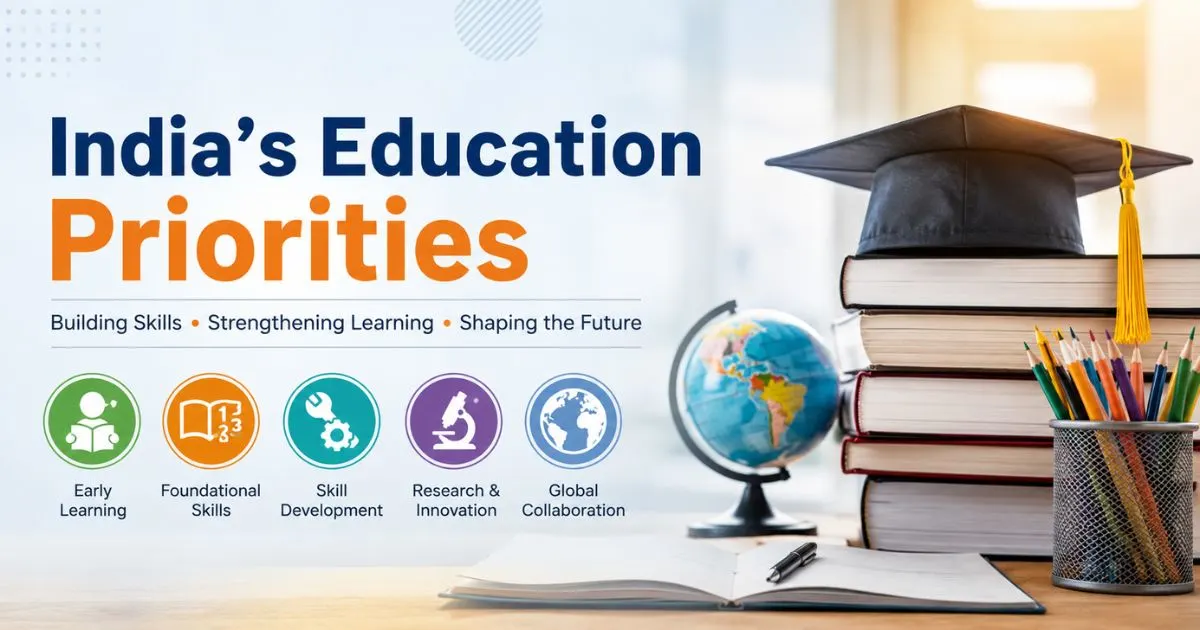
by India’s education system is moving towards a more future-ready approach that goes beyond marks and traditional classroom learning. Greater attention is being given to foundational learning, early childhood education, skill development, vocational training, research and innovation.
These priorities aim to give students stronger learning foundations and better prepare them for higher education, careers and a changing global environment.
India’s Education System Gets a New Direction: Key Priorities for Students, Skills and Higher Education
India’s education system is entering an important phase of change, with greater attention being given to foundational learning, skill development, research, innovation and international academic cooperation.
Union Education Minister Pralhad Joshi recently reviewed the ongoing work of the Ministry of Education after returning from the 13th BRICS Education Ministers’ Meeting held in Bhubaneswar, Odisha. The review focused on the next steps for existing education programmes and the areas that need stronger implementation.
For students and educators, the importance of these discussions goes beyond government meetings. The priorities discussed at the national and international levels could influence how children learn, how young people develop job-ready skills and how Indian universities connect with global education systems.
Focus on Building a Future-Ready Education System
The Education Ministry has placed emphasis on creating an education system that is inclusive, modern and prepared for future opportunities.
According to the priorities discussed by Joshi, education should not focus only on examinations and academic degrees. Students also need practical skills, research exposure, creativity and the ability to adapt to changing career opportunities.
The broader objective is to develop learners who can compete globally while remaining connected to India’s social, cultural and human values.
This approach is particularly important as technology, artificial intelligence and changing employment patterns continue to transform the skills required in the workplace.
Stronger Focus on Early Childhood Education
One of the important outcomes of the 13th BRICS Education Ministers’ Meeting was greater emphasis on Early Childhood Care and Education (ECCE).
Early education plays an important role in a child’s overall development. The first few years of learning can influence language development, basic cognitive abilities, social skills and future academic performance.
A strong foundation at this stage can help children enter formal schooling with better learning readiness.
For parents and educators, this means that early childhood education should not be viewed simply as preparation for school. It is an important part of a child’s long-term educational journey.
Foundational Literacy and Numeracy Remain Important
Another major area of focus is Foundational Literacy and Numeracy (FLN).
Before students can successfully understand advanced subjects, they need strong basic reading, writing and mathematical skills.
Improving foundational learning can therefore have a long-term impact on school education. Children who struggle with basic literacy or numeracy in the early grades may find it difficult to keep pace with the curriculum as they move into higher classes.
The emphasis on FLN indicates the importance of strengthening basic learning outcomes rather than focusing only on syllabus completion.
More Importance to Skill Development and Vocational Education
The education system is also expected to place greater emphasis on skills and vocational learning.
The BRICS education discussions highlighted cooperation in skill development and Technical and Vocational Education and Training (TVET).
For students, this can be significant because today’s employment market increasingly values practical abilities along with formal qualifications.
Vocational education can provide students with opportunities to develop skills that are directly connected with industries and emerging occupations.
A stronger connection between education and employment can also help young people make more informed career choices.
Research, Innovation and Start-ups
Higher education is another major area where the focus is shifting towards research and innovation.
The BRICS declaration highlighted the need to strengthen research, innovation and start-up ecosystems.
For universities and colleges, this can mean greater emphasis on creating an environment where students and researchers can develop new ideas and turn them into practical solutions.
Students may benefit from greater exposure to:
- Research projects
- Innovation programmes
- Entrepreneurship
- Start-up opportunities
- Industry collaboration
- New technologies
Such opportunities can help move higher education beyond classroom-based learning and encourage students to become problem-solvers and innovators.
International Recognition of Qualifications
Another important area discussed at the BRICS education meeting was Mutual Recognition of Qualifications (MRQ).
The basic idea is to improve cooperation between participating countries so that academic and professional qualifications can be more easily understood and recognised across borders.
For Indian students, stronger international academic cooperation could eventually create more opportunities for higher studies, research and professional mobility in other countries.
However, the practical benefit will depend on how such frameworks are implemented by participating institutions and countries.
Traditional and Indigenous Knowledge in Education
India also highlighted cooperation on traditional and indigenous knowledge systems.
The BRICS discussions welcomed India’s initiative concerning academic collaboration in this area. There was also a proposal for the BRICS Network University to consider traditional and indigenous knowledge systems as an additional international thematic group.
This reflects an effort to connect modern education and research with knowledge developed through India’s long cultural and intellectual traditions.
Such an approach can create opportunities for academic research in areas where traditional knowledge can be studied alongside modern scientific methods.
Teachers and Researchers at the Centre
A future-ready education system cannot depend only on new policies and technology. Teachers, researchers and students remain central to its success.
The discussions emphasised keeping learners, teachers, researchers and young people at the centre of education policymaking and international cooperation.
For teachers, this highlights the importance of continuous professional development and access to modern teaching methods.
For students, it means educational reforms should ultimately improve the quality and accessibility of learning rather than simply create new administrative structures.
What These Education Priorities Could Mean for Students
The latest priorities point towards an education system with a broader definition of learning.
Instead of concentrating only on marks and examinations, the emerging approach places importance on foundational learning, practical skills, research, innovation and global exposure.
Students could increasingly need a combination of academic knowledge and practical abilities to succeed in higher education and employment.
Parents and students should therefore pay attention not only to examination results but also to skill development, communication, digital abilities, creativity and career-oriented learning.
The Bigger Picture for Indian Education
The 13th BRICS Education Ministers’ Meeting has provided a platform for India to discuss education cooperation with other BRICS countries. India’s 2026 BRICS Chairship theme focuses on resilience, innovation, cooperation and sustainability, and these ideas were also reflected in the education discussions.
The real impact, however, will depend on implementation.
Policies related to early childhood education, foundational learning, vocational skills, research and international qualifications can make a meaningful difference only when they reach schools, colleges, universities, teachers and students.
For India’s education system, the challenge is therefore not simply to announce new priorities but to ensure that these priorities translate into better learning outcomes and wider opportunities for young people.
Conclusion
India’s education priorities are gradually moving towards a broader and more future-oriented model of learning.
Early education, foundational literacy, vocational skills, research, innovation and international academic cooperation are becoming important parts of this approach.
For students, the message is clear: education is becoming more than obtaining a degree or scoring marks. Building practical skills, developing curiosity, learning continuously and being prepared for a changing world will become increasingly important for long-term success.