 by
Christmas is a wonderful time for children to express their creativity, show appreciation, and make something special for the people they love. However, preparing homemade presents does not have to involve expensive supplies, complicated instructions, or hours of crafting. With a few everyday materials, children can create thoughtful gifts that feel personal and festive.
Fortunately, many DIY Christmas gifts take just 5–20 minutes to assemble. For example, children can decorate bookmarks for their favorite readers, turn paper scraps into colorful Christmas cards, or transform clean jars into cheerful candle holders for battery-operated tea lights. Even better, these activities give children opportunities to practise fine motor skills, follow simple steps, make independent choices, and experience the joy of giving.
Whether you are a parent planning a cozy afternoon at home, a teacher preparing a classroom activity, or a caregiver organizing a holiday craft session, the following ideas offer something for different ages and abilities. Moreover, most projects use inexpensive materials that you may already have in your home or classroom.
Quick Tips Before Starting Christmas Crafts
Before choosing a project, consider the child’s age, available time, and comfort with different materials. Although some children enjoy cutting and folding paper, others may prefer painting, sticking, or choosing colors.
- Prepare supplies beforehand: Place the required materials in small trays so children can begin without searching for everything.
- Choose a realistic time limit: Allow an extra five minutes for drying, cleaning, and wrapping.
- Keep the child’s creativity at the center: Instead of aiming for perfect results, encourage personal touches and original designs.
- Reuse household materials: Cardboard, ribbons, paper bags, and clean containers can make excellent craft supplies.
- Adjust tasks to suit individual needs: Offer pre-cut shapes, larger stickers, easy-grip tools, or adult assistance whenever helpful.
- Prioritize safety: Adults should handle hot glue guns, sharp tools, and other potentially hazardous materials. Also, keep small parts away from young children who may put them in their mouths.
Most importantly, remember that a homemade gift does not need to look professionally made. Its value comes from the time, thought, and effort a child puts into creating it.
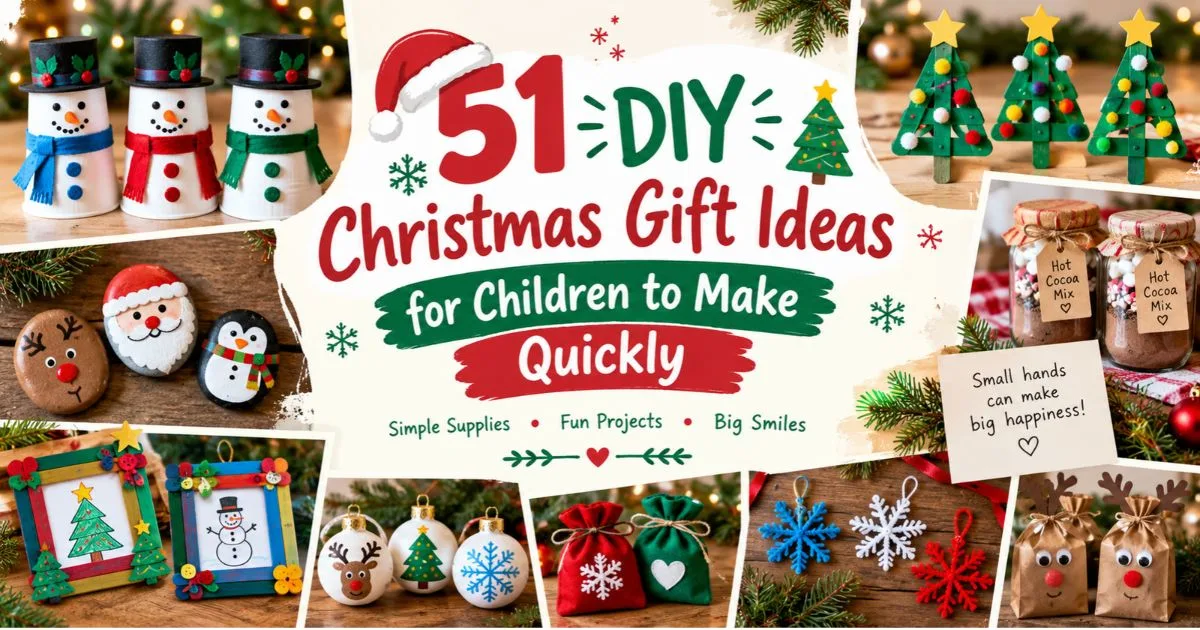
51 DIY Christmas Gift Ideas for Children to Make Quickly
Paper and Card Christmas Gifts
These projects are especially useful when you need inexpensive gifts for classmates, relatives, teachers, or neighbors. Furthermore, paper crafts require little storage space and can usually be completed with basic classroom supplies.
1. Handmade Christmas Greeting Cards
Time: 10–15 minutes | Materials: Cardstock, crayons, markers, stickers, glue
A handmade greeting card is a simple way for children to share Christmas wishes. First, fold a piece of cardstock in half. Next, ask the child to draw a Christmas tree, a snowman, a star, or a favorite holiday scene on the front.
After decorating the picture, children can write a short message inside, such as “Wishing you a happy Christmas!” Younger children can dictate their message to an adult or add their name and a colorful drawing instead.
Personal touch: Include a small handwritten reason why the recipient is special.
2. Personalized Christmas Bookmarks
Time: 5–10 minutes | Materials: Thick paper, markers, ribbon, stickers
For someone who enjoys reading, a personalized bookmark is both useful and easy to make. Cut cardstock into long rectangles and let children decorate each one with festive patterns, stars, candy canes, or tiny books.
Then, punch a hole near the top and thread through a short piece of ribbon, with adult assistance where needed. Finally, write the recipient’s name or add a short message about reading.
Personal touch: Add a favorite reading quote or draw a character the recipient loves.
3. Christmas Paper Snowflakes
Time: 5–10 minutes | Materials: White paper, child-safe scissors, crayons
Paper snowflakes make delicate decorations for bedrooms, windows, and holiday displays. Fold a square sheet of paper several times, then help the child cut small shapes along the folded edges. When the paper opens, an individual snowflake pattern appears.
Children can make several snowflakes and arrange them in a small envelope to create a ready-to-use decoration set.
Personal touch: Write the year and the child’s name on the back of one snowflake.
4. Mini Christmas Art Prints
Time: 10–15 minutes | Materials: Paper, crayons or washable paint, cardboard backing
Children can turn their drawings into miniature artworks for grandparents, relatives, or teachers. Give them small sheets of paper and invite them to create a festive picture using their favorite colors.
Once the artwork is dry, mount it on a slightly larger piece of cardboard to create a simple border. Add the child’s name and a short title underneath.
Personal touch: Make the artwork about a shared memory, a family pet, or a favorite Christmas tradition.
5. Paper Christmas Ornaments
Time: 10 minutes | Materials: Colored paper, glue, string, stickers
Instead of buying ready-made ornaments, children can create their own using paper circles, stars, bells, or tree shapes. Cut out two matching shapes, decorate them, and glue them together with a loop of string secured between the layers.
For added interest, children can use different paper colors or combine patterns from old wrapping paper.
Personal touch: Add the child’s name or the recipient’s initials.
6. Accordion Paper Christmas Trees
Time: 10–15 minutes | Materials: Green paper, glue, small stickers, cardboard
Fold a strip of green paper back and forth like an accordion. Then fold or gather it into a fan-shaped tree and attach it to a small cardboard base. Children can decorate the tree with tiny paper circles, stars, or drawn ornaments.
An adult can prepare the folds in advance for younger children who find repeated folding difficult.
Personal touch: Attach a little paper star carrying the recipient’s name.
Time: 5–10 minutes | Materials: Card scraps, string, markers, hole punch
Gift tags are useful presents for people who enjoy wrapping gifts. Cut leftover cardstock into small rectangles, circles, or festive shapes. Children can decorate them with patterns and write simple messages such as “Made with love” or “For you.”
Punch a hole in each tag and thread through a short piece of string. Bundle five or six tags together with ribbon.
Personal touch: Give each tag a different design so the recipient can use it throughout the holiday season.
8. Christmas Paper Chains
Time: 10–15 minutes | Materials: Colored paper strips, glue stick or tape, markers
Paper chains turn ordinary paper into colorful decorations. Cut paper into strips and show children how to connect each strip into a loop, passing the next strip through the previous loop before closing it.
Use red, green, white, gold, or any colors the child prefers. Once the chain is complete, fold it neatly and package it as a decoration kit for a family member.
Personal touch: Add a small card suggesting where the recipient could hang the chain.
9. Christmas Coupon Book
Time: 10–15 minutes | Materials: Paper, crayons, stapler or ribbon
A coupon book gives children a way to offer helpful actions rather than another physical object. They can create coupons for activities such as helping tidy toys, reading a story together, watering plants, or setting the table.
Write one promise on each small page, decorate the cover, and fasten the pages together with adult assistance if using a stapler.
Personal touch: Choose promises the child can realistically fulfil, rather than chores that depend on adult permission or complicated arrangements.
10. Christmas Paper Picture Frame
Time: 10–15 minutes | Materials: Cardboard, colored paper, glue, crayon
A handmade frame can turn a favorite family photo into a meaningful present. An adult can cut a rectangular frame from sturdy cardboard, leaving an opening in the center. Children can cover it with colored paper and decorate the edges with stars, drawings, or paper shapes.
Attach a cardboard backing and a simple stand or hanging loop. Add the photo after the decorations are complete.
Personal touch: Write the date or a short caption along the bottom edge.
11. Christmas Paper Gift Bags
Time: 10 minutes | Materials: Plain paper bags, stickers, markers, ribbon
Plain paper bags can become attractive gift packaging with very little effort. Children can draw Christmas trees, add colorful stickers, or make a pattern of stars and snowflakes.
If the bags have no handles, an adult can punch holes and attach ribbon. The finished bags can hold cookies, bookmarks, cards, or other small homemade presents.
Personal touch: Draw a picture of the recipient on the front, if the child wishes.
12. Handmade Christmas Paper Fans
Time: 10–15 minutes | Materials: Colored paper, crayons, tape, ribbon
Fold a rectangular piece of paper into narrow accordion pleats. Bring the lower edges together and secure them with tape to form a fan. Children can decorate the paper before folding it or add small drawings afterward.
These fans work well as lightweight room decorations or festive additions to a handmade gift basket.
Personal touch: Use colors that match the recipient’s room or favorite things.
13. Christmas Story Booklet
Time: 15–20 minutes | Materials: Paper, crayons, stapler or string
Children who enjoy storytelling can make a tiny illustrated Christmas book. Fold several sheets of paper in half, then create a short story across four to six pages.
The story could feature a lost mitten, a helpful reindeer, a snowman’s adventure, or a family preparing for a holiday meal. Children can draw one picture per page and add a title to the cover.
Personal touch: Include the recipient as a character in the story, with their permission.
14. Christmas Paper Mosaic Art
Time: 10–15 minutes | Materials: Paper scraps, glue, thick paper, pencil
A paper mosaic is a great way to reuse small pieces of colored paper. Draw a simple outline of a tree, star, stocking, or bell. Next, let children tear or place small paper pieces inside the outline, leaving little gaps if they prefer a mosaic effect.
Once complete, the design can be displayed as a mini art piece or included in a greeting card.
Personal touch: Choose a shape connected to the recipient’s favorite holiday decoration.
15. Christmas Handprint Art
Time: 10–15 minutes, plus drying time | Materials: Paper, washable paint or crayons, markers
Handprint art helps preserve a child’s creativity at a particular age. Children can trace their hands onto paper and turn the outline into a Christmas tree, reindeer antlers, or a festive wreath.
Alternatively, they can make a simple handprint using washable paint, provided the child is comfortable with the sensation and an adult supervises the activity.
Personal touch: Add the child’s name and the date so the recipient can keep it as a memory.
16. Christmas Paper Rosettes
Time: 10–15 minutes | Materials: Paper strips, glue, cardboard circles, string
Fold long strips of colored paper into accordion pleats. Join the ends to form a ring, then gently spread the folds into a rosette. Glue a small cardboard circle in the middle to help secure the shape.
Children can make one large rosette or several smaller ones for a gift bundle.
Personal touch: Write a cheerful message on the center circle.
17. Christmas Origami Book Corners
Time: 10–15 minutes | Materials: Square paper, markers, stickers
Book-corner bookmarks slip over the corner of a page rather than sitting between pages. With a simple folding tutorial or adult demonstration, children can turn square paper into a pocket-shaped corner bookmark.
Decorate the front as a reindeer, snowman, elf, or cheerful monster. Draw the face and add paper details with glue.
Personal touch: Pair the bookmark with a handwritten reading recommendation.
18. Recycled Christmas Postcards
Time: 5–10 minutes | Materials: Clean cardboard packaging, paper, markers, glue
Reuse the plain side of clean cardboard packaging to create sturdy postcards. Cut the cardboard into postcard-sized rectangles and cover any distracting printed areas with paper.
Children can draw a winter scene or a holiday message on one side. On the other, they can write the recipient’s name and a personal greeting.
Personal touch: Make a set of three postcards with different designs.
19. Christmas Paper Wreath
Time: 10–15 minutes | Materials: Green paper, cardboard ring, glue, ribbon
Cut a ring from cardboard and prepare several paper leaves. Children can arrange and glue the leaves around the ring until it looks full. Then, add small paper berries, a bow, or a star.
An adult can pre-cut the ring and leaf shapes to make the process faster.
Personal touch: Add a small paper heart with a message for the recipient.
20. Christmas Paper Pencil Toppers
Time: 5–10 minutes | Materials: Paper, crayons, tape, pencils
Children can create tiny Christmas characters to decorate ordinary pencils. Draw a small tree, star, reindeer face, or snowman on paper, then cut out two matching shapes and attach them around the top of a pencil using tape.
Keep the design lightweight so the pencil remains easy to use.
Personal touch: Give the pencils to a teacher or a friend who enjoys drawing and writing.
Handmade Gifts Using Recycled and Household Materials
The next group makes good use of items that might otherwise be discarded. In addition, these crafts help children understand that thoughtful gifts do not have to be expensive or made from brand-new supplies.
21. Decorated Glass Jar for Keepsakes
Time: 10–15 minutes | Materials: Clean jar, paper, ribbon, stickers
A clean, unchipped jar can become a container for buttons, craft supplies, notes, or other small keepsakes. Children can decorate the outside with paper shapes, ribbon, or a removable paper label.
Make sure the jar is dry before decorating it. If it is intended for young children, choose a safer, unbreakable container instead.
Personal touch: Add a label such as “Little Treasures” or “Happy Memories.”
22. Cardboard Tube Christmas Characters
Time: 10–15 minutes | Materials: Clean cardboard tubes, paper, glue, markers
Turn an empty cardboard tube into a Christmas elf, reindeer, snowman, or Santa-inspired character. Cover the tube with paper, draw a face, and attach simple paper accessories.
Adults should check that the tubes are clean and suitable for the intended use. For younger children, supervise small decorations and use larger paper pieces.
Personal touch: Make a character that represents the recipient’s favorite Christmas story.
23. Recycled Cardboard Christmas Coasters
Time: 10–15 minutes | Materials: Clean cardboard, paper, glue, markers
Cut several equal-sized squares or circles from sturdy cardboard. Cover both sides with paper and decorate them with simple geometric patterns, stars, or Christmas trees.
These are best presented as decorative coasters for dry cups rather than as waterproof or heat-resistant tableware.
Personal touch: Create a coordinated set of four with a different design on each one.
24. Fabric Scrap Christmas Garland
Time: 10–15 minutes | Materials: Fabric scraps, ribbon or string, scissors
Children can transform leftover fabric into a soft decorative garland. With adult help, cut fabric into short strips and tie them along a length of ribbon or string.
Choose contrasting colors and patterns, and leave enough space between the knots so the garland hangs neatly.
Personal touch: Include a small tag explaining that the garland was made from reused fabric.
25. Cardboard Christmas Tree Decoration
Time: 10–15 minutes | Materials: Cardboard, crayons, string, glue
Cut a simple tree shape from cardboard and let children decorate it with colored paper, drawings, or small stickers. Make a hole near the top and thread through a loop of string.
The ornament can hang on a Christmas tree, a bedroom hook, or a classroom display.
Personal touch: Write a favorite family holiday activity on the back.
26. Recycled Paper Bead Necklace
Time: 15–20 minutes | Materials: Paper strips, glue stick, string
Turn colorful paper into decorative beads by rolling long, narrow triangles around a pencil or thin dowel. Secure the tips with a small amount of glue and let the beads dry before threading them onto string.
Because small beads can pose a choking risk, this activity is suitable only with age-appropriate supervision. For very young children, make a larger paper-bead garland instead of wearable jewelry.
Personal touch: Alternate colors to create a pattern inspired by the recipient’s favorite colors.
27. Handmade Fabric Bookmark
Time: 10–15 minutes | Materials: Fabric scraps, ribbon, fabric-safe adhesive
If you have leftover fabric, cut a long strip and fold the edges inward. An adult can help secure the edges with suitable fabric adhesive or stitching.
Children can choose the pattern, add a ribbon loop, or attach a small fabric shape. Let the adhesive dry according to its instructions before giving the bookmark away.
Personal touch: Select a fabric pattern that reflects the recipient’s interests.
28. Recycled Greeting Card Ornament
Time: 10 minutes | Materials: Old greeting cards, scissors, ribbon, glue
Old holiday cards often contain attractive pictures and patterns. Cut out a festive image or a favorite illustration, then mount it on cardboard to create a durable ornament.
Punch a hole at the top and add a ribbon loop. Children can decorate the back with a handwritten note.
Personal touch: Choose an image that reminds the recipient of a favorite place or shared memory.
29. Cardboard Desk Organizer
Time: 15–20 minutes | Materials: Small clean boxes, paper, glue, markers
A few small cardboard boxes can become a useful organizer for pencils, paper clips, or art supplies. Arrange the boxes side by side, secure them with adult assistance, and cover the outside with colored paper.
Children can label each compartment and decorate the front. Choose a stable base so the organizer does not tip easily.
Personal touch: Add the recipient’s name or a label that matches how they plan to use it.
30. DIY Christmas Memory Cards
Time: 10–15 minutes | Materials: Cardstock, markers, stickers, envelopes
Memory cards are small illustrated cards that capture enjoyable experiences. Children can make a set featuring favorite family activities, such as baking together, visiting a park, reading bedtime stories, or decorating the Christmas tree.
Write one memory on each card and place the set in a decorated envelope.
Personal touch: Include a blank card where the recipient can add a favorite memory of their own.
Edible and Kitchen-Inspired Christmas Gifts
Food gifts can be enjoyable to prepare together, especially when children like measuring, decorating, and arranging ingredients. Nevertheless, adults should supervise kitchen activities, check allergies, and ensure that food is stored safely.
31. Homemade Hot Chocolate Gift Mix
Time: 10 minutes | Materials: Cocoa powder, sugar, suitable dry milk powder if desired, clean food-safe jar
Children can help layer a simple hot chocolate mix in a clean, dry, food-safe container. An adult should select and measure the ingredients according to a tested recipe, while the child pours the prepared portions into the jar.
Attach a label listing every ingredient and explaining how much mix to add to a cup of hot milk or water, according to the recipe. Adults should prepare the hot drink when it is time to serve it.
Personal touch: Add a handwritten serving suggestion or a festive paper tag.
Time: 10–15 minutes to assemble | Materials: Plain cookies, food-safe bags or containers, icing or sprinkles
Instead of baking an entire batch of decorated cookies, prepare a small decorating kit. Place a few plain, cooled cookies in a food-safe container and package suitable decorations separately.
Children can help arrange the kit and make a colorful instruction card. An adult should check ingredients, allergies, food hygiene, and safe storage before gifting.
Personal touch: Include a simple drawing showing one possible cookie design.
33. Christmas Trail Mix Gift Pack
Time: 5–10 minutes | Materials: Suitable cereal, dried fruit, optional chocolate chips, food-safe packaging
Children can help assemble a festive snack mix using ingredients selected by an adult. For example, a suitable mixture might include cereal, raisins, and a small amount of chocolate chips.
Check allergies and dietary restrictions first. Clearly label ingredients and avoid nuts or other problematic foods when the recipient’s needs are unknown. Do not give choking-hazard ingredients to young children.
Personal touch: Name the mix something cheerful, such as “Christmas Crunch.”
Time: 10–15 minutes | Materials: Clean food-safe tin, paper, ribbon, stickers
A plain tin can become attractive packaging for homemade cookies or other suitable treats. Children can decorate the lid with a paper circle, festive drawings, or a ribbon tied around the tin.
Place food in a suitable liner or food-safe wrapping, and use only a clean container appropriate for food storage.
Personal touch: Add a label with the child’s name and a short holiday greeting.
35. Homemade Cinnamon-Scented Gift Sachet
Time: 10–15 minutes | Materials: Small fabric pouch, cinnamon sticks, dried orange peel
For a simple decorative gift, place a small amount of cinnamon sticks and completely dried orange peel in a fabric pouch. Children can help select the materials and tie the pouch closed with ribbon.
This is a scented keepsake, not an edible gift. Keep it away from children who may mouth the contents, pets that could chew it, and anyone with relevant fragrance sensitivities.
Personal touch: Attach a paper tag with a simple festive design.
36. Christmas Tea Gift Envelope
Time: 5–10 minutes | Materials: Individually wrapped tea bags, paper envelope, markers
Children can decorate an envelope or small paper pouch to hold individually wrapped tea bags. Let them draw a mug, snowflakes, or a cheerful winter scene on the front.
Choose sealed tea products suitable for the recipient, and avoid adding loose ingredients unless you can label and package them appropriately.
Personal touch: Add a note inviting the recipient to enjoy a quiet cup of tea.
Useful Christmas Gifts Children Can Make
A practical gift can be especially meaningful because the recipient can use it after the holiday season. These projects are also suitable for classroom gift exchanges, with small adjustments to match children’s abilities.
37. Personalized Pencil Holder
Time: 10–15 minutes | Materials: Clean sturdy container, colored paper, glue, markers
Choose a clean, stable container with smooth edges and cover the outside with colored paper. Children can decorate it with stars, geometric shapes, animals, or festive patterns.
Check that the container will stand upright and that any covering is firmly attached before filling it with pencils.
Personal touch: Add a small label describing the holder’s intended use.
38. Handmade Notepad Cover
Time: 10–15 minutes | Materials: Plain notepad, cardstock, glue, stickers
A basic notepad becomes more personal with a decorated cover. Measure the front of the notepad, cut a piece of cardstock to fit, and attach it without obstructing the pages.
Children can add the recipient’s name, favorite colors, or a simple illustration. Choose a design that will remain useful beyond Christmas.
Personal touch: Write a cheerful message on the first page.
39. DIY Christmas Pencil Set
Time: 5–10 minutes | Materials: Plain pencils, paper, tape, markers
Wrap narrow strips of decorative paper around the upper portion of a few pencils, leaving the sharpened ends and writing surfaces clear. Secure the paper with a small amount of suitable adhesive or tape.
Children can create matching designs for a teacher, classmate, or sibling. Keep the pencils comfortable to hold and easy to sharpen.
Personal touch: Bundle three pencils with different patterns and tie them with ribbon.
40. Decorated Reusable Shopping Bag
Time: 10–15 minutes, plus drying time | Materials: Plain reusable fabric bag, suitable fabric markers
A plain fabric bag can become a useful gift when decorated with fabric-safe markers. Children can draw stars, flowers, animals, or simple repeating patterns.
An adult should check the marker instructions and allow the design to dry or set as directed before the bag is used or washed.
Personal touch: Add a small drawing connected to the recipient’s hobbies.
41. Handmade Family Recipe Card
Time: 10–15 minutes | Materials: Cardstock, markers, a family recipe
Children can create a keepsake recipe card for a family member who enjoys cooking. An adult can write or print the accurate recipe, while the child decorates the border and adds a small illustration of the finished dish.
Include ingredient quantities and preparation steps clearly so the card is genuinely useful.
Personal touch: Choose a recipe the child has enjoyed making or eating with the recipient.
42. Christmas Reading Challenge Jar
Time: 10–15 minutes | Materials: Clean jar or box, paper slips, markers
Write simple reading activities on paper slips, such as “Read a story with an animal,” “Choose a book about space,” or “Read together for ten minutes.” Children can decorate the container and place the folded slips inside.
The recipient can draw one slip whenever they want a new reading activity.
Personal touch: Add a few suggestions that reflect the recipient’s favorite subjects.
43. Handmade Door Hanger
Time: 10–15 minutes | Materials: Cardboard, crayons, scissors, ribbon
Cut a large, sturdy shape with a central opening that can fit over a door handle. Children can decorate the hanger with a cheerful message, stars, or a favorite character.
An adult should prepare the opening and check that the hanger fits without scratching the door or interfering with a latch.
Personal touch: Write a friendly message such as “Have a lovely day” on one side.
44. Christmas Plant Pot Cover
Time: 10–15 minutes | Materials: Paper or fabric, ribbon, clean plant pot
A simple plant pot can look festive when children create a removable decorative sleeve. Measure the pot, cut paper or fabric to fit around the outside, and secure it with ribbon or removable tape.
Keep drainage holes clear and avoid trapping water against the pot. If gifting a plant, choose one that is appropriate for the recipient’s home and pets.
Personal touch: Add a label with the plant’s name or a short encouraging message.
45. DIY Christmas Desk Calendar
Time: 15–20 minutes | Materials: Cardstock, markers, calendar pages, cardboard stand
Children can decorate a small desk calendar using printed monthly pages or blank pages prepared by an adult. Create a simple cardboard stand, then attach the pages with a clip or another suitable binding method.
Make sure the dates are accurate and easy to read. Children can decorate the margins with seasonal drawings, animals, or geometric patterns.
Personal touch: Mark birthdays or other dates only with the recipient’s permission.
Personalized and Sentimental Christmas Gifts
Sometimes the most memorable presents are not the most elaborate ones. In fact, a short note, a thoughtful drawing, or a collection of shared memories can mean more than a costly item.
46. “Reasons I Appreciate You” Jar
Time: 10–15 minutes | Materials: Jar or box, paper slips, pens
Ask children to write or dictate short notes about why they appreciate someone. Examples include “You help me when I feel stuck,” “You read funny stories,” or “I love playing games with you.”
Fold the notes and place them in a decorated jar. For younger children, drawings can communicate the same feelings just as effectively.
Personal touch: Encourage specific, genuine messages instead of copying the same sentence repeatedly.
47. Handmade Christmas Memory Book
Time: 15–20 minutes | Materials: Folded paper, crayons, string or staples
A small memory book gives children a place to record favorite moments with someone they love. Each page can feature a drawing, a short sentence, or a memory from the past year.
For example, children might illustrate a picnic, a family game night, or a trip to a favorite place. An adult can help write down the child’s words without changing their meaning.
Personal touch: Leave one page blank for the recipient to add a memory later.
48. Personalized Name Art
Time: 10–15 minutes | Materials: Paper, markers, stickers, colored pencils
Write the recipient’s name in large letters across a sheet of paper. Children can fill each letter with a different pattern, such as dots, stripes, tiny stars, or small drawings.
Mount the finished artwork on cardboard for a simple display. If the recipient prefers a particular color or theme, use that preference as inspiration.
Personal touch: Add a small illustration representing something the recipient enjoys.
49. Christmas Handwritten Letter
Time: 10–15 minutes | Materials: Paper, envelope, pens, stickers
A personal letter is a thoughtful present for grandparents, teachers, relatives, or friends. Children can write about a favorite memory, something they appreciate, or an activity they hope to enjoy together.
If writing is difficult, the child can dictate the letter while an adult writes the words. The child can then sign their name or add a drawing.
Personal touch: Include one specific thank-you rather than only a general holiday greeting.
50. DIY Christmas Family Portrait
Time: 10–20 minutes | Materials: Paper, crayons, markers, optional cardboard frame
Invite children to draw the people, pets, or other family members who make them feel at home. They can include favorite clothing colors, familiar objects, or a place where the family enjoys spending time.
There is no need to aim for realistic proportions. Instead, let children decide how to represent the people who matter to them.
Personal touch: Ask the child to give the picture a title, such as “Our Happy Home” or “Christmas Together.”
51. A “Let’s Spend Time Together” Gift Voucher
Time: 5–10 minutes | Materials: Cardstock, crayons, markers, ribbon
Children can make a voucher for a shared activity rather than a physical object. Ideas include playing a board game together, taking a nature walk, reading a favorite story, having a drawing session, or helping prepare a simple snack.
Decorate the voucher, describe the activity clearly, and agree on a realistic time to enjoy it. For activities requiring adult permission, make sure the recipient is comfortable with the plan.
Personal touch: Add a message explaining why the child would especially enjoy sharing that activity with the recipient.
How to Choose the Best Quick Christmas Gift
Although all 51 ideas can work well, the best choice depends on the recipient and the child’s abilities. Therefore, consider the following quick guide before selecting a project.
| Recipient | Suitable gift ideas | Why they work |
|---|---|---|
| Parents or grandparents | Memory book, family portrait, appreciation jar | Personal and meaningful |
| Teachers | Bookmarks, pencil sets, greeting cards | Useful and easy to distribute |
| Friends or classmates | Paper ornaments, pencil toppers, postcards | Colorful and inexpensive |
| People who enjoy reading | Bookmarks, story booklets, reading challenge jars | Encourages reading |
| People who enjoy cooking | Recipe cards, cookie decorating kits | Practical and activity-based |
| Neighbors or relatives | Greeting cards, gift tags, paper wreaths | Simple to make in multiples |
| Children who enjoy art | Mini art prints, mosaics, name art | Encourages creative expression |
Christmas Gift-Making Activities for Different Ages
Not every child will be comfortable with the same craft. For this reason, adjust the complexity rather than expecting every child to complete an identical project.
Preschool Children
Children in this age group may enjoy sticker cards, handprint art, paper ornaments, and simple drawings. Adults can prepare shapes beforehand and allow children to choose the colors or decorations.
Elementary School Children
Many school-age children can manage folded-paper crafts, bookmarks, gift tags, decorated bags, and simple booklets with limited help. As their confidence grows, encourage them to plan the design and complete more of the steps independently.
Older Children and Preteens
Older children may prefer more detailed projects, such as recipe cards, reading challenge jars, memory books, recycled desk organizers, and paper-bead crafts. They can also help organize supplies or prepare a small gift-making station for younger siblings.
Children With Different Learning or Sensory Needs
Offer flexible ways to participate. For instance, one child might enjoy drawing while another prefers arranging shapes or selecting stickers. Pre-cut materials, thicker markers, visual instructions, fewer steps, and short breaks can make the activity more comfortable.
Additionally, avoid insisting that a child touch paint, glue, fabric, or scented materials if the texture or smell is unpleasant. A successful craft is one that allows the child to participate in a way that works for them.
How to Organize a Quick Christmas Gift-Making Session
If you plan to make several gifts in one afternoon, a little organization can save time and reduce mess.
- Choose two or three projects. Start with crafts that use similar materials, such as paper, markers, and ribbon.
- Prepare individual supply kits. Place the materials for each project together before children begin.
- Show one finished example. A sample helps children understand the goal without forcing them to copy it exactly.
- Break the task into short steps. Demonstrate one step at a time, especially for younger children.
- Allow time for drying. Complete another paper-based activity while painted or glued items dry.
- Add a personal message. Encourage children to sign their gifts or explain why they chose them.
- Wrap the gifts simply. Reused paper bags, clean boxes, ribbon, and handmade tags are usually enough.
For a classroom or summer-camp-style activity, prepare different stations for paper crafts, recycled materials, and personal messages. As a result, children can move between tasks according to their interests and finish gifts at a comfortable pace.
Frequently Asked Questions
What are the easiest DIY Christmas gifts for children to make?
Handmade greeting cards, bookmarks, gift tags, paper ornaments, and handwritten letters are among the easiest options. They require few materials, involve relatively simple steps, and can often be completed in 5–15 minutes.
What Christmas gifts can children make in under 10 minutes?
Children can decorate greeting cards, prepare gift tags, personalize bookmarks, decorate paper bags, make simple postcards, or assemble a small tea gift envelope. However, allow additional time if cutting, drying, or adult assistance is needed.
What are some inexpensive Christmas gifts children can make at home?
Paper snowflakes, coupon books, recycled cardboard ornaments, memory cards, name art, and appreciation jars are inexpensive choices. Furthermore, reusing clean cardboard, scrap paper, ribbon, and containers can reduce the need to buy new supplies.
What can children make for their teachers at Christmas?
Useful options include personalized bookmarks, handmade cards, pencil sets, notepad covers, and small desk organizers. A short, sincere thank-you note can make any of these gifts more meaningful.
How can children make Christmas gifts without complicated craft supplies?
Start with paper, pencils, crayons, cardboard, glue sticks, and clean reusable containers. With these basic materials, children can create dozens of decorations, cards, keepsakes, and practical gifts.
How do I make Christmas crafts suitable for children with different abilities?
Provide alternative ways to participate, such as drawing instead of cutting, choosing decorations instead of gluing, or using pre-cut shapes. Also, offer clear instructions, flexible timing, and adult support when needed. The goal is meaningful participation rather than a perfectly finished product.
How can I help children make gifts quickly without doing everything for them?
Prepare the materials in advance, demonstrate the first step, and let children make their own design choices. If a step is difficult or unsafe, an adult can handle that part while the child remains involved in selecting colors, decorating, or writing the message.
Making Christmas gifts does not need to be complicated or expensive. With a few everyday materials and a little preparation, children can create thoughtful presents that reflect their personalities and relationships.
From simple bookmarks and paper ornaments to memory books and appreciation jars, these 51 DIY Christmas gift ideas offer plenty of ways to make holiday crafting enjoyable. Moreover, the activities encourage creativity, practical problem-solving, communication, and generosity.
Ultimately, the most valuable part of a homemade Christmas gift is not how polished it looks. Instead, it is the opportunity for a child to say, in their own way, “I made this especially for you.”