 by
Helping a child with ADHD stay focused, remember instructions, or move from one activity to another can sometimes feel like a daily challenge. For example, a child may understand a lesson perfectly well but struggle to finish the worksheet because nearby sounds, movement, or unrelated thoughts keep pulling their attention away. Similarly, another child may find it difficult to sit still, organize materials, or remember the next step in a familiar routine.
Fortunately, learning does not always have to happen while sitting quietly at a desk. In fact, short, playful activities can provide children with opportunities to practise attention, movement control, working memory, and flexible thinking.
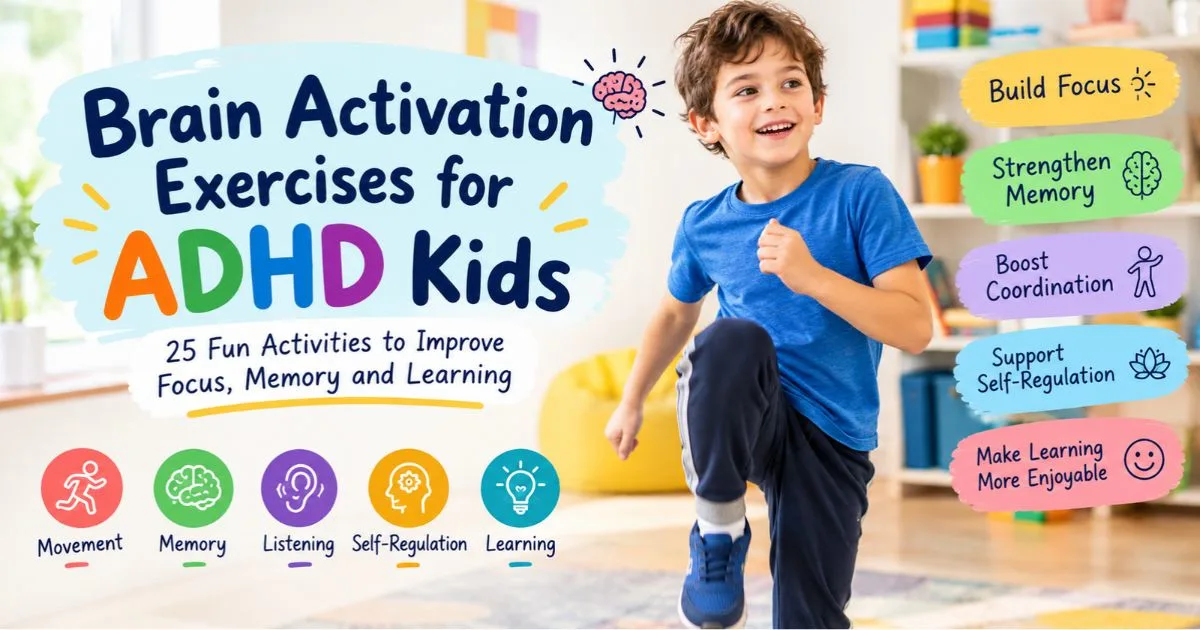
Brain activation exercises are simple activities that engage children physically or mentally. They may include movement games, memory challenges, rhythm activities, breathing exercises, and problem-solving tasks. Rather than expecting children to concentrate for long periods, these exercises break learning into manageable and enjoyable experiences.
However, every child with ADHD has different strengths, preferences, and support needs. Therefore, an activity that works well for one child may not suit another. The goal is not to force children to behave in a particular way but to help them discover practical strategies that make everyday learning more comfortable.
What Are Brain Activation Exercises for ADHD Kids?
Brain activation exercises are structured activities that encourage children to use skills such as listening, remembering, coordinating movements, noticing patterns, and shifting attention between tasks.
For children with ADHD, these activities can serve as opportunities to practise executive-function skills. These include planning, working memory, impulse control, and managing transitions.
For instance, a child might follow a sequence of claps, remember three movements, or listen for a particular word during a story. In each case, the activity gives the child a clear goal and immediate feedback.
Nevertheless, it is important to understand that these exercises do not cure ADHD, replace professional care, or guarantee improvements in attention. Instead, they can complement appropriate educational strategies, supportive routines, physical activity, and individualized ADHD treatment when needed.
Brain Activation Exercises for ADHD Kids
1. Cross-Body Movement Challenge
Best for: Movement coordination and body awareness
Cross-body movements encourage children to coordinate opposite sides of their bodies while following simple instructions.
How to do it:
- Ask your child to stand comfortably with enough space around them.
- Invite them to touch their right hand to their left knee.
- Next, ask them to touch their left hand to their right knee.
- Alternate sides slowly for 30–60 seconds.
- Once your child understands the pattern, introduce a gentle rhythm or count aloud.
Initially, keep the movements slow and predictable. Afterwards, increase the pace only if your child enjoys the challenge.
Helpful tip: If standing movements are uncomfortable, perform the activity while seated. The objective is participation, not perfect coordination.
2. Freeze-and-Move Dance
Best for: Listening, movement control, and transitions
Music can make movement breaks more enjoyable. Moreover, a freeze-dance game gives children a clear signal for when to start and stop moving.
How to do it:
- Play a favourite child-friendly song.
- Encourage your child to dance, march, or move freely.
- Pause the music unexpectedly.
- Ask your child to freeze in a comfortable position.
- Restart the music after a few seconds.
Begin with short pauses so the game remains enjoyable. Gradually, your child can practise responding to different signals, such as clapping or a spoken word.
Helpful tip: Celebrate participation rather than criticizing every movement. Some children may need extra time to stop their bodies when a signal changes.
3. Copy-the-Leader Game
Best for: Observation, imitation, and following instructions
Children often engage more readily when an adult joins the activity instead of simply giving directions.
How to do it:
- Stand or sit facing your child.
- Perform one simple movement, such as tapping your shoulders.
- Ask your child to copy you.
- Introduce another movement, such as raising both hands.
- Gradually combine two or three movements into a short sequence.
For example, clap twice, touch your shoulders, and raise your hands. Your child then repeats the sequence.
As your child becomes comfortable, switch roles and let them become the leader.
Helpful tip: Keep early sequences short. After all, a successful experience can encourage participation more effectively than a complicated challenge.
4. Clap-and-Repeat Rhythm Game
Best for: Auditory attention and short-term memory
Rhythm games offer a simple way to practise listening carefully and reproducing a pattern.
How to do it:
- Clap once and ask your child to repeat it.
- Next, clap twice with a brief pause between the claps.
- Introduce a pattern such as clap-clap-pause-clap.
- Let your child reproduce the pattern.
- If they enjoy the activity, use a small drum, a tabletop, or gentle foot taps.
Initially, use only two or three sounds. Later, add a longer pattern if your child remains interested.
Helpful tip: Avoid turning mistakes into a test. Repeat the pattern together and allow your child to try again.
5. Simon Says
Best for: Listening, response inhibition, and attention shifting
Simon Says is a classic activity that can be adapted for different ages and abilities.
How to do it:
- Give a direction beginning with “Simon says,” such as “Simon says touch your nose.”
- Encourage your child to follow the instruction.
- Occasionally give a direction without saying “Simon says.”
- Explain that the child should follow only the instructions with the special phrase.
- Keep the game playful and offer reminders when necessary.
For younger children, use familiar movements. Meanwhile, older children may enjoy combining instructions, such as “Simon says clap twice and then sit down.”
Helpful tip: If the stop-and-start rule becomes frustrating, remove the elimination element. The child can simply practise identifying the special phrase.
6. Balloon Keep-Up
Best for: Visual tracking, movement, and coordination
A lightweight balloon moves slowly enough to give many children time to follow its path.
How to do it:
- Choose a lightweight balloon and clear the play area.
- Gently tap the balloon upward.
- Invite your child to keep it from touching the floor.
- Count the successful taps together.
- Introduce a variation by asking your child to alternate hands or take turns with you.
The game can provide a short movement break before homework or another seated task.
Safety note: Supervise young children, especially around broken balloons, because balloon pieces can present a choking hazard. Avoid balloons if your child has a latex allergy.
7. Red Light, Green Light
Best for: Listening and controlling movement in response to signals
This activity helps children practise starting and stopping an action when a signal changes.
How to do it:
- Mark a short, clear starting point.
- Say “green light” to invite your child to walk or march.
- Say “red light” to signal a stop.
- Alternate between the two signals.
- Once the child understands the game, introduce “yellow light” for slow movement.
Keep the distance short and the rules consistent.
Helpful tip: Walking is enough. Running is not necessary, particularly in a small room or crowded space.
8. Picture Memory Challenge
Best for: Visual memory and observation
A picture-based game can make remembering information more accessible for children who prefer visual learning.
How to do it:
- Place three familiar objects on a table.
- Allow your child to look at them for about 10 seconds.
- Cover the objects with a cloth.
- Ask your child to name the items they remember.
- Uncover the objects and discuss what was remembered.
After several enjoyable rounds, add one more object if your child is ready.
Alternatively, show a picture containing several familiar items and ask your child to identify what they noticed.
Helpful tip: Treat this as a memory game, not a diagnostic test. Performance can vary with fatigue, interest, stress, and other factors.
9. Animal Movement Break
Best for: Whole-body movement and body awareness
Animal movements add imagination to physical activity, making a break feel more like play than an exercise routine.
How to do it:
- Walk like a bear using comfortable, controlled movements.
- Stretch upward like a giraffe.
- Take gentle sideways steps like a crab.
- Hop like a frog if the child can do so safely.
- Flap your arms like a bird.
Choose three movements and spend approximately 20–30 seconds on each.
Afterwards, offer water or a quiet moment before returning to the next task.
Helpful tip: Adapt the movements to your child’s mobility and comfort. Seated animal actions are equally suitable when needed.
Best for: Visual search and systematic observation
Searching for an object gives children a concrete goal and encourages them to examine their surroundings.
How to do it:
- Hide a familiar toy in an easy-to-find location.
- Explain where the search can take place.
- Ask your child to find the toy.
- If necessary, provide a clue such as “Look near something blue.”
- Gradually make the clues more descriptive.
For older children, offer two clues in sequence or ask them to explain how they searched.
Helpful tip: Keep the first rounds short. An object that is too difficult to find may turn an enjoyable game into a frustrating experience.
11. Follow the Sound
Best for: Listening and identifying sounds
This activity encourages children to notice differences between familiar sounds.
How to do it:
- Choose several safe sound sources, such as a bell, a gentle hand clap, or a tapping sound.
- Ask your child to close their eyes if comfortable, or simply look away.
- Make one sound.
- Invite your child to identify the sound source.
- Repeat with a different sound.
You can also ask your child to point towards the sound or match it to a picture.
However, keep the volume comfortable and never use sudden, startling noises.
12. One-Minute Sorting Game
Best for: Categorization and organizing information
Sorting games help children practise noticing similarities and following a simple organizing rule.
How to do it:
- Gather safe, familiar objects such as large blocks, crayons, or toy animals.
- Ask your child to sort them by colour.
- Next, try sorting by type or size.
- Change the sorting rule and ask your child to reorganize the objects.
- Discuss the rule together before starting each round.
For example, first sort blocks by colour and then group them by shape.
Helpful tip: Use a timer only if it motivates your child. Otherwise, let the child finish without a time limit.
13. Storytelling With Missing Words
Best for: Listening, language, and remembering details
Interactive storytelling encourages children to listen for meaning and contribute their own ideas.
How to do it:
- Start a short story about a familiar topic.
- Pause before a predictable word.
- Invite your child to supply the missing word.
- Continue the story and pause again.
- Finally, ask your child to describe one thing that happened.
For example: “A little rabbit walked into the garden and found a red ____.”
Your child might answer “flower,” “ball,” or another imaginative possibility.
Helpful tip: Accept reasonable creative answers. The goal is engagement and communication, not memorizing a particular script.
14. Pattern-Building With Blocks
Best for: Pattern recognition and problem-solving
Building patterns lets children work with something they can see and touch.
How to do it:
- Place a red block beside a blue block.
- Add another red block.
- Ask your child which colour should come next.
- Build a longer pattern together.
- Invite your child to create a pattern for you to copy.
Later, introduce patterns involving three colours or different shapes.
Helpful tip: Start with a pattern that has an obvious solution. Then, increase the complexity gradually according to your child’s interest.
15. Opposite Action Game
Best for: Flexible thinking and response control
In this game, children practise doing the opposite of a familiar action.
How to do it:
- Explain the rule with an example.
- Say “hands up” while demonstrating hands down.
- Ask your child to perform the opposite action.
- Try simple pairs such as stand/sit or open/close hands.
- Switch roles and allow your child to give the instructions.
Because the rules require children to pause and consider what they heard, the activity can be an enjoyable way to practise response control.
Helpful tip: Demonstrate slowly and repeat the rule when necessary. Avoid introducing too many opposite pairs at once.
16. Balloon Breathing
Best for: Practising calm breathing and noticing body sensations
Some children benefit from a brief, predictable pause after an exciting or demanding activity.
How to do it:
- Invite your child to sit or stand comfortably.
- Ask them to imagine their tummy is a balloon.
- Breathe in gently through the nose if comfortable.
- Breathe out slowly without forcing the breath.
- Repeat for three to five comfortable breaths.
You can also place a soft toy on the child’s tummy while they lie down and observe its gentle movement.
Helpful tip: Never require deep breathing or breath-holding. If the activity feels uncomfortable, stop and try a different calming strategy.
17. Copy the Shape
Best for: Visual attention and motor planning
Simple drawing activities can combine observation with hand movements.
How to do it:
- Draw a circle, triangle, or square on paper.
- Ask your child to copy the shape.
- Next, draw a pattern containing two shapes.
- Invite the child to reproduce the pattern.
- Let the child design a pattern for you to copy.
For children who dislike drawing, use blocks, magnetic shapes, or large objects to build the same patterns.
Helpful tip: Focus on experimenting and completing the activity rather than producing perfect shapes.
18. The Three-Step Mission
Best for: Following instructions and working memory
Everyday tasks can become short missions that encourage children to remember a sequence.
How to do it:
- Give two simple instructions, such as “Pick up your pencil and bring your notebook.”
- Allow your child to complete them.
- Once comfortable, introduce a third step.
- Ask the child to repeat the instructions if that helps.
- Gradually reduce reminders only when the child can manage comfortably.
For example, a mission could be: “Take your book, place it on the table, and bring your pencil.”
Helpful tip: Written or picture-based instructions are useful alternatives. Needing reminders is not a failure; external supports can help children complete everyday tasks.
19. Find the Difference
Best for: Visual comparison and noticing details
Spot-the-difference activities encourage children to compare two images rather than scan randomly.
How to do it:
- Choose two simple pictures with a few differences.
- Place them side by side.
- Ask your child to identify one difference.
- Encourage them to move systematically from one part of the picture to another.
- If needed, point to a section to help them begin.
Start with large, obvious differences before introducing smaller details.
Helpful tip: Allow plenty of time. The purpose is to practise observation, not to finish faster than someone else.
20. Number-and-Movement Game
Best for: Number recognition, listening, and movement
Combining numbers with movement can make a short learning break more engaging.
How to do it:
- Say a number between one and five.
- Ask your child to perform that many gentle movements.
- For example, the number three means three claps.
- Change the movement each round.
- If appropriate, let your child choose both the number and movement.
For an easier version, show the number on a card. For a more challenging version, say two numbers in sequence and ask the child to remember both.
Helpful tip: Choose movements that are safe for the available space and the child’s physical abilities.
21. The Quiet Detective
Best for: Environmental awareness and selective listening
This game invites children to notice sounds without requiring them to identify every sound around them.
How to do it:
- Sit together in a comfortable room or outdoor space.
- Listen quietly for 10–20 seconds.
- Ask your child to name one sound they noticed.
- Invite them to identify another sound if they wish.
- Discuss whether the sounds were near or far away.
For example, your child may notice a fan, birds, footsteps, or distant traffic.
Helpful tip: Some children find quiet listening uncomfortable or distracting. Keep the activity optional and move to a quieter location when appropriate.
22. Obstacle Course at Home
Best for: Movement planning, spatial awareness, and physical activity
A small obstacle course provides a practical way to add movement to the day.
How to do it:
- Arrange cushions on the floor, leaving clear walking space.
- Ask your child to walk around a cushion.
- Add a large, stable object to step over only if it is safe.
- Include a target such as placing a beanbag in a basket.
- Let your child help design the next course.
Keep the course simple, and supervise the activity.
Safety note: Avoid unstable furniture, slippery surfaces, elevated jumps, and obstacles that could cause falls.
23. Word Association Chain
Best for: Verbal flexibility and idea generation
A word chain can help children practise connecting ideas in a playful conversation.
How to do it:
- Say a familiar word, such as “apple.”
- Ask your child to name something related, such as “fruit.”
- Continue with another connection, such as “banana.”
- Take turns adding words.
- If the child becomes stuck, provide two possible choices.
You can use themes such as animals, food, school supplies, or favourite stories.
Helpful tip: Accept different reasonable associations. The game should encourage communication rather than test the child’s vocabulary.
24. Puzzle Power Break
Best for: Reasoning, visual problem-solving, and persistence
A suitable puzzle gives children an opportunity to work through a challenge in manageable steps.
How to do it:
- Choose a puzzle that matches your child’s current ability.
- Begin with a small section or a few pieces.
- Encourage your child to look for matching colours, edges, or shapes.
- Offer a hint if frustration begins to build.
- Pause or switch activities when the child has had enough.
Puzzles may include simple jigsaws, shape sorters, matching cards, or age-appropriate logic games.
Helpful tip: Finishing the puzzle is not the only successful outcome. Trying a strategy, asking for help, or returning after a break also counts as progress.
25. Plan-Do-Check Activity
Best for: Planning, task completion, and self-monitoring
Children often find multi-step tasks easier when the steps are visible. Therefore, this activity uses a simple routine to make task completion more manageable.
How to do it:
- Plan: Choose one small task, such as organizing a pencil box.
- Do: Complete the task one step at a time.
- Check: Look at the result together.
- Ask what helped and what could make the task easier next time.
- Use the same process for another familiar task when appropriate.
For younger children, draw three pictures representing the steps. Older children may prefer a written checklist.
Helpful tip: Treat the checking stage as problem-solving rather than criticism. The child should feel supported, not judged.
How to Choose the Right Brain Activation Exercises
Although all 25 activities offer opportunities for practice, it is not necessary to introduce them together. Instead, choose activities based on what your child needs at a particular moment.
| Your child’s situation | Activities to try |
|---|---|
| Needs a movement break | Freeze-and-move dance, animal movements, balloon keep-up |
| Finds listening instructions difficult | Simon Says, clap-and-repeat, the three-step mission |
| Enjoys visual tasks | Picture memory, pattern-building, find the difference |
| Needs help transitioning between activities | Red Light, Green Light, Copy-the-Leader |
| Benefits from a quiet pause | Balloon breathing, quiet detective |
| Enjoys solving problems | Puzzles, hidden objects, Plan-Do-Check |
However, use these suggestions as starting points rather than fixed rules. For instance, a child who enjoys movement may prefer a quiet puzzle after an active game, while another child may need a longer physical break before sitting down to learn.
How Long Should ADHD Brain Activation Exercises Last?
There is no single ideal duration for every child with ADHD. Age, interest, fatigue, the difficulty of the activity, and the environment can all influence how long a child wants to participate.
As a practical starting point, try a short activity lasting two to five minutes. If the child remains engaged, continue a little longer. On the other hand, if the child becomes frustrated or overwhelmed, simplify the activity or stop.
The following sample schedule illustrates how to include activities without filling the entire day with exercises.
| Time or situation | Suggested activity | Approximate duration |
|---|---|---|
| Before homework | Animal movement break | 2–3 minutes |
| Before a reading task | Clap-and-repeat rhythm | 1–2 minutes |
| Between lessons | Freeze-and-move dance | 2–4 minutes |
| During a quiet break | Balloon breathing | 1 minute |
| Before finishing the day | Plan-Do-Check | 3–5 minutes |
These durations are flexible examples, not clinical recommendations. In addition, children do not need to complete every activity every day.
Tips for Making Brain Activation Exercises More Effective
Keep instructions short and clear
First, explain one step at a time. Next, demonstrate what you mean. Finally, invite your child to try. This approach reduces the amount of information the child must process at once.
Offer choices whenever possible
Instead of insisting on one activity, offer two suitable options. For example, ask, “Would you like to do a dance break or an animal walk?” Consequently, your child has some control over how they participate.
Use predictable routines
A consistent sequence can make transitions easier. For example, your child might complete a short movement break, drink water, and then begin homework. Over time, familiar routines may reduce uncertainty.
Make the environment easier to manage
Whenever possible, reduce unnecessary noise, clear the workspace, and keep only the materials needed for the current activity nearby. Additionally, visual schedules and checklists can help children understand what happens next.
Praise effort and useful strategies
Notice specific actions, such as following the first instruction, asking for clarification, or returning to a task after a break. Rather than focusing only on correct answers, recognize the strategies your child uses.
Adjust activities to the child’s interests
Some children enjoy music, whereas others prefer building, drawing, stories, or outdoor play. Therefore, connect exercises with familiar interests whenever possible. An activity that feels enjoyable is often easier to sustain.
Allow breaks without treating them as failure
If an exercise becomes tiring, stop or simplify it. Children with ADHD may experience fluctuating attention and energy throughout the day. Consequently, flexibility is more useful than insisting on identical performance every time.
Do Brain Activation Exercises Cure ADHD?
No. Brain activation exercises do not cure ADHD, and claims that particular movements, brain games, or short routines permanently rewire the brain should be treated cautiously.
Nevertheless, structured play, regular physical activity, supportive classroom adjustments, predictable routines, and opportunities to practise everyday skills can be useful parts of a child’s broader support plan.
ADHD is a neurodevelopmental condition that can affect attention, activity levels, and impulse control. Appropriate support may include parent training, behavioural interventions, educational accommodations, and medication when recommended by a qualified healthcare professional.
Therefore, if your child’s symptoms interfere with learning, friendships, sleep, family life, or everyday activities, consider speaking with a pediatrician or qualified mental health professional. An individualized assessment can help identify which supports are appropriate.
Frequently Asked Questions
1. What are the best brain activation exercises for ADHD kids?
The most suitable activities depend on the child’s age, preferences, and support needs. Movement games, rhythm imitation, visual puzzles, sorting activities, and short instruction-following games are useful starting points. Choose activities that are safe, enjoyable, and easy to adapt.
2. Can brain exercises improve focus in children with ADHD?
Some activities provide opportunities to practise listening, remembering instructions, coordinating movements, and managing transitions. However, improvements during a particular game do not necessarily transfer to classroom attention or other everyday situations. Therefore, use these exercises alongside appropriate support rather than relying on them alone.
3. How often should children with ADHD do brain activation exercises?
You can introduce brief activities when they fit naturally into the child’s day, such as before homework or between lessons. There is no universal frequency that works for every child. Adjust the routine according to the child’s interest, energy, and response.
4. Are movement exercises helpful for children with ADHD?
Physical activity can support general health and may help some children feel more ready to engage in a task afterwards. However, responses vary. Offer safe movement opportunities and observe which activities your child finds helpful.
5. Which brain activation exercises can children do at home?
Children can try freeze dance, picture-memory games, balloon breathing, pattern-building, simple puzzles, animal movements, and storytelling. Most require little equipment. Nevertheless, supervise activities that involve physical movement or small objects.
6. Are these exercises suitable for preschool children with ADHD?
Many can be adapted for preschool-aged children, particularly imitation games, movement activities, simple sorting, and short storytelling tasks. Keep the rules simple, use brief sessions, and supervise closely. If a child has developmental or sensory needs, adjust the activity accordingly.
7. What should parents do if a child refuses to participate?
First, avoid turning the activity into a battle. Offer a choice, demonstrate the game, or try a different activity. In addition, consider whether the child is tired, hungry, overwhelmed, or simply uninterested. Refusal does not automatically indicate poor motivation or an inability to learn.
8. Can teachers use these exercises in the classroom?
Yes, many activities can be adapted for classroom use. For example, teachers can offer brief movement breaks, rhythm games, visual sorting tasks, or short instruction-following activities. However, exercises should complement individualized educational supports rather than replace them.
Brain activation exercises can make learning more active, flexible, and enjoyable for children with ADHD. From cross-body movements and freeze dance to visual puzzles and short planning tasks, each activity offers a different way to practise useful everyday skills.
Most importantly, children do not need to perform perfectly for an activity to be worthwhile. Instead, focus on participation, encouragement, and finding the strategies that suit the individual child.
Start with one or two simple activities, observe how your child responds, and make changes when necessary. Over time, these small, supportive experiences can become part of a more comfortable learning routine—alongside appropriate educational, family, and professional support. We do not claim any treatment.